
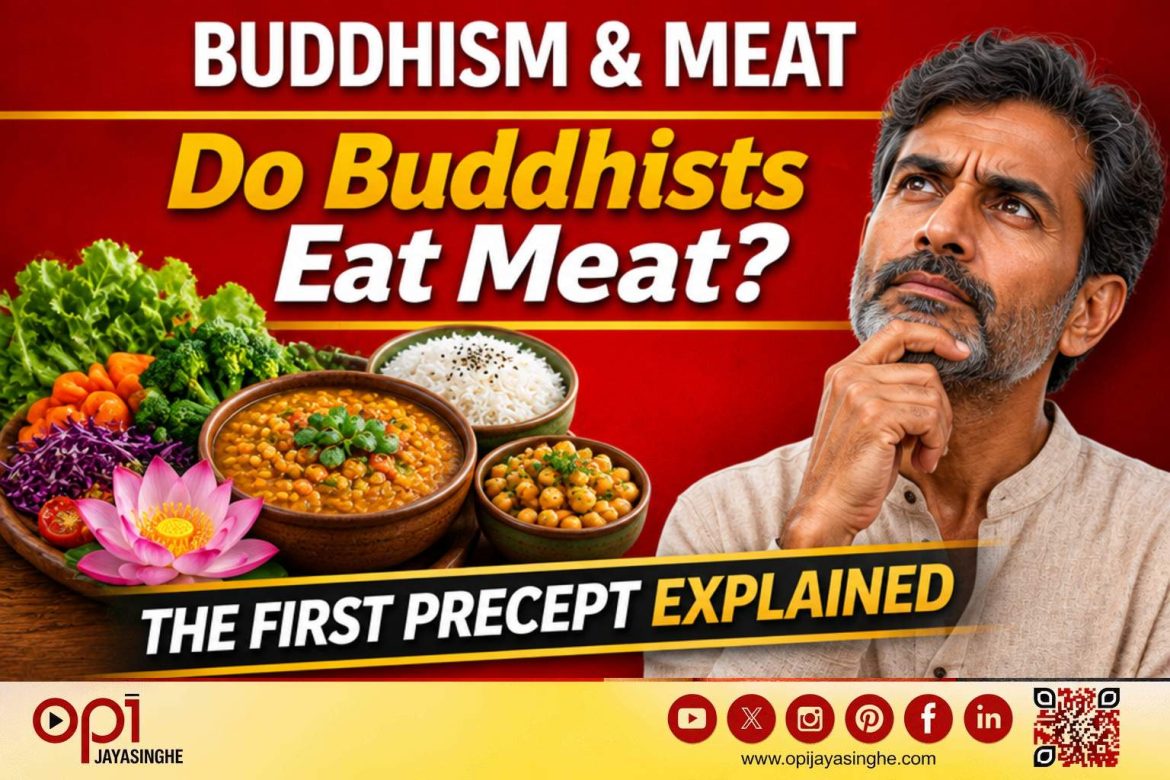
I want to talk about a dream I’ve had for a long time. It’s a message I’ve been trying to get across for years, and it starts with a question I first asked as a boy: do Buddhists eat meat? In my experience, most do. I was born a Buddhist, and I think the majority of us are hypocrites on this one. The first precept says we shall refrain from killing, yet most Buddhists I grew up with ate chickens, pigs, cows and sheep without thinking twice. I’d like to make a documentary about that gap.
Key takeaways
- Many Buddhists eat meat. Theravada monks in countries like Sri Lanka and Thailand eat what they’re offered, while many Mahayana monks and nuns in East Asia are vegetarian.
- The usual justification is “I didn’t kill it, someone else did.” The Buddha’s three conditions in the Jīvaka Sutta are often read that way.
- In a supermarket world, buying meat creates the demand that breeds and kills the animal. I can’t square that with the first precept.
- A balanced, whole-food, plant-based diet can do more than keep you alive. With a B12 supplement, you can thrive on it.
- I want to make a documentary on this, using AI for much of the footage plus real interviews, with the end of 2027 as my goal.
Do Buddhists eat meat? The short answer
Yes, many Buddhists eat meat, and many don’t. It depends on the tradition, the country and the person.
In Theravada countries like Sri Lanka, Thailand and Myanmar, a monk eats whatever is put in his alms bowl or served at the monastery, and lay people eat pretty much what everyone else eats. In much of East Asian Mahayana Buddhism, monks and nuns are strictly vegetarian, and texts like the Laṅkāvatāra Sūtra argue hard against eating the flesh of animals. Tibetan Buddhists have historically eaten meat, partly because so little grows on the plateau. Even the Dalai Lama has spoken in favour of vegetarianism while admitting he has found it hard to keep to.
So Buddhists are not vegetarians as a rule. I think we should be, and I want to explain why meat eating never sat right with me.
The first precept and “someone else killed it”
The first of the five precepts is the training rule to abstain from taking life. As a kid I understood it simply: I shall refrain from killing any animal.
Yet the large majority of Buddhists still eat animals and animal products. When I asked the elders about it, I got the same answer every time. We’re not the ones killing these animals. The animal is already dead, that’s why it’s in the shop. We don’t see it hurt, we don’t condone it and we didn’t ask for it. It’s just there, so we buy it, and we’re okay to eat it. That’s the Buddhist doctrine, and we’re following it.
It took me a long, long time to realise what kind of nonsense that is. Put it through any test, never mind a stress test, and it falls over.
Why some Buddhists don’t eat beef
Some Buddhists, including many in Sri Lanka, won’t eat beef. When I asked why, I was told the cow gives us milk, ploughs the land and gives manure for fertiliser, so out of respect for the cow we don’t eat it. The same respect for the cow is a big part of why so many people in India don’t eat beef either.
That always struck me as odd. If the cow deserves respect for what it does for us, why doesn’t the chicken, or the pig, or the sheep? None of them want to die.
What the Buddha said about eating meat
This is the part of the doctrine people point to and hide behind, so I want it shown verbatim in the documentary.
In the Jīvaka Sutta (MN 55), the Buddha says a monk shouldn’t eat meat if he has seen, heard or suspected that the animal was killed specially for him. If none of those three apply, the meat is allowed. The monastic rules in the Vinaya also forbid ten types of meat: human, elephant, horse, dog, snake, lion, tiger, leopard, bear and hyena. When Devadatta proposed to the Buddha that monks should be strictly vegetarian, the Buddha refused to make it a rule.
There’s another teaching people talk about less. In the Vaṇijjā Sutta (AN 5.177), the Buddha lists five trades a lay follower shouldn’t engage in, and two of them are business in living beings and business in meat.
My trouble with this is that those rules came from monks who walked from house to house with a bowl and ate whatever was given. Today, nobody hands me a plate of leftovers. I walk into a supermarket and choose to buy meat. If we’re not allowed to trade in meat, how is it fine to be the customer who keeps the trade going? If it’s wrong, let’s call it out and say it’s wrong. We have to use common sense in the modern day.
Demand creates supply
When you get to the root of why most Buddhists eat meat, it’s “we didn’t kill it, someone else did, so we’re allowed to eat it.”
But we are the people creating the demand, so the supply gets created as a result. One triggers the other. If there’s no demand, the supply would shrink on its own.
Most people don’t see that this is how the world works. Farm animals are mass-produced to feed people. Cows are artificially inseminated, and the same goes for many other animals, to breed more and more to feed the masses. Most of us never realise this cycle can be broken, and that we don’t need to kill animals to eat well.
The result is that billions, if not trillions, of innocent animals are slaughtered every year so we can satisfy our taste buds. And we tell ourselves, and our children, that it has nothing to do with us.
A cow in Sri Lanka
My own awakening started at Sunday school. I asked these questions and got the answer above, and for years I didn’t put two and two together, because eating meat was so normal.
One memory from Sri Lanka has stayed with me. I remember a cow being taken away to slaughter. You look into the cow’s eyes and there are tears running down. These are sentient beings who want to live, the same living beings the first precept tells us not to harm. No animal wants to die, however small it is.
We call most of this slaughter “humane killing”. That’s an oxymoron. You can’t be a human who wants to live, kill another sentient being and call it humane.
Can you thrive without meat?
Growing up, I hadn’t met anyone who was vegan or even trying to eat without animal products. There were vegetarians, but a fully plant-based diet was a foreign concept to me. I didn’t know it was possible. When you’re served meat every day, that becomes your norm, especially in Western cultures, where a meal is meat, potatoes and some veggies.
We’re not taught that a meal doesn’t need meat, fish or poultry. It can be legumes, fruit, vegetables and whole grains, foods that don’t cause animal suffering. You can eat that way and thrive.
What about protein?
“You need meat for protein” has become a cliché. Walk into any Western hospital and you won’t find people dying of protein deficiency. It just doesn’t happen. If you’re eating enough calories from a varied diet, you’re getting enough protein.
If you’re going to the gym to bulk up and add mass, more protein helps. But that’s no different whether you’re plant-based, an omnivore or on a carnivore diet. An average person with an average lifestyle doesn’t need to supplement with protein. I’ve written about another common worry, how to get enough iron without eating meat.
The fibre problem
What you will find in those hospitals is the result of not enough fibre. People in many Western nations don’t eat enough fruit, vegetables, legumes and other plant foods, and low fibre intake is linked to a wide range of diseases. Fibre only comes from plants. NutritionFacts.org has a good collection of the research on it.
B12, the one supplement
When I went plant-based, I asked myself whether I’d be deficient in anything. The only supplement I needed was vitamin B12.
Most people don’t realise B12 isn’t made by the animal. It’s made by bacteria found in soil. Farm animals, including poultry and other livestock, are often given B12 supplements themselves. They’re the middleman. Because our food and water are so clean today, we don’t pick it up the way we once did. One small supplement, daily or weekly, is a small price to pay for an optimal diet that’s cruelty-free. I explain which form I take in my post on cyanocobalamin vs methylcobalamin.
The doctors I learned from
It took me months of intense study before I made the change, book after book and lecture after lecture. My favourite author is Dr Michael Greger, who runs NutritionFacts.org, a non-profit. He has published hundreds, if not thousands, of articles there, free to read and not sponsored. That’s the main thing. His books How Not to Die, How Not to Diet, How Not to Age and the latest, How Not to Hurt, are bestsellers, and he gives the proceeds to charity. His Daily Dozen is still how I build my plate.
Others I learned from include Dr Pam Popper, Dr Caldwell Esselstyn, Dr T. Colin Campbell, Dr John McDougall and Dr Neal Barnard, who runs the Physicians Committee for Responsible Medicine. All of them taught me that a balanced, whole-food diet without animal products lets you not only survive but thrive.
The documentary I want to make
This is the vision. The film opens with a young boy, in theory me, asking these questions at Sunday school and getting the “someone else killed it” answer. It follows that boy as he grows up, ponders why the answer isn’t right, and finally makes the change.
Along the way I want to show the Buddhist doctrine verbatim, the parts people hide behind, and ask whether it needs to be updated or refined, so people aren’t lying to themselves and to their children. I’d like to interview prominent guests on why an animal-free diet is the optimal diet. There’s a handful of Buddhist monks who advocate a vegan diet, and I’d like to find them and interview them. I’ve written before about the life lessons I took from Ven. Soma Thera, and monks like him are the voices I want in this film.
A large part of the film can be made with AI, then mixed with real footage from those interviews. I don’t have a set length in mind. I’d love for it to end up on a big platform like Netflix. Even without that, if I can leave this documentary as a legacy, dedicated to the innocent lives lost to animal agriculture, with its focus on Buddhists hiding behind their doctrine to justify eating animals, I’d be very happy with that.
The first steps are to pin down the key themes, storyboard it, write a script and cut it down. There’s no hard deadline, but I believe finishing it by the end of 2027 is very achievable.
FAQ
Can I be Buddhist and still eat meat?
Yes. Most Buddhist traditions don’t require you to be vegetarian, and many Buddhists eat meat. My view is that buying meat creates the demand for killing, which sits badly with the first precept.
Are Buddhist monks allowed to eat meat?
In the Theravada tradition, monks may eat meat they’re offered as long as they haven’t seen, heard or suspected the animal was killed for them. Many Mahayana monks and nuns in China, Taiwan, Korea and Vietnam are vegetarian.
What foods are forbidden in Buddhism?
The Vinaya forbids monks ten types of meat: human, elephant, horse, dog, snake, lion, tiger, leopard, bear and hyena. Many monastic communities also avoid alcohol, and some Mahayana traditions avoid onion and garlic as well.
Why don’t some Buddhists eat beef?
Out of respect for the cow, because it gives milk, ploughs the fields and provides manure for fertiliser. That’s what I was taught in Sri Lanka.
Why do Tibetan Buddhists eat meat?
Very little grows on the Tibetan plateau, so meat and dairy have long been part of the diet there. Some Tibetan teachers now encourage people to eat less meat or none.
Do you have to be vegan to be Buddhist?
No. Being Buddhist doesn’t require a vegan or vegetarian diet. But if you take the first precept seriously, I think a plant-based diet is the most honest way to live it.
To your health
If you’re a Buddhist who eats meat, ask yourself the question I asked as a boy, and stay with it a little longer than the elders did. Next time you’re in the supermarket, remember who creates the demand. To good health, to your health, and to your prosperity.
This article shares my personal views and experience and is not medical advice. Please talk to your doctor before changing your diet or supplements.